
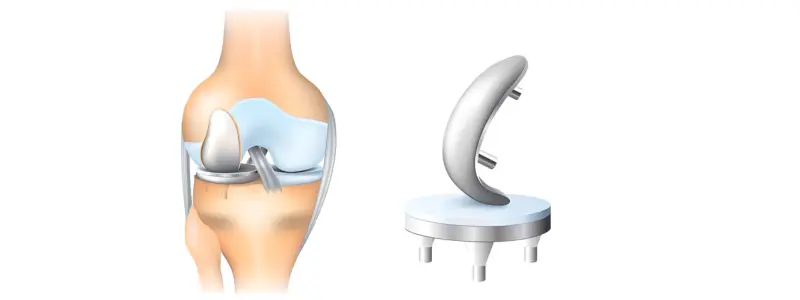
Arthritis doesn't always ruin the whole knee. In many people especially in the earlier stages the wear is confined to just one part of the joint, while the rest stays healthy. When that's the case, replacing the entire knee can mean giving up good cartilage and ligaments you didn't need to lose. Partial knee replacement resurfaces only the worn compartment and leaves the healthy structures alone. PMG Hospital is an NABH-certified partial knee replacement hospital in Ahmedabad caring for patients across Gujarat, and the procedure is led by partial knee replacement doctor in Ahmedabad, Dr. Hiren Patel. Because the whole point is to operate only where you truly need it, getting the assessment right is the most important step of all.
What Is Partial Knee Replacement?
Partial knee replacement also called unicompartmental knee replacement, and sometimes microplasty resurfaces only the damaged compartment of the knee (medial/inner, lateral/outer, or patellofemoral/kneecap), while the healthy bone, cartilage and, crucially, the cruciate ligaments (ACL and PCL) are preserved. Keeping those ligaments is what gives a partial knee its more natural feel and stability compared with a total replacement. It's a smaller, less invasive operation but it's only the right choice when the damage is genuinely limited to one area, which is why a careful, compartment-specific diagnosis by an experienced partial knee replacement specialist in Ahmedabad matters so much.
Are You a Candidate for Partial Knee Replacement?
Studies suggest a meaningful share of people referred for knee replacement by various estimates from roughly a quarter to as many as half have arthritis confined to one compartment and may be suitable for a partial procedure rather than a total one. The deciding factors are the pattern of wear and the health of your ligaments.
| You may be a good fit for partial replacement if… | A total replacement may be better if… |
|---|---|
| Arthritis or damage is limited to one compartment | Arthritis affects two or three compartments |
| Your ligaments especially the ACL are still healthy | The ACL is damaged or deficient |
| You have early or localised osteoarthritis | You have widespread "bone-on-bone" wear |
| You want to preserve as much natural knee as possible | There's a significant knee deformity |
Only imaging and a proper examination can confirm this which is exactly why an honest evaluation comes before any decision at PMG Hospital.
Partial vs Total Knee Replacement - How They Compare
Both operations relieve arthritis pain well. The differences are in how much is removed and how recovery tends to go.
| Partial Knee Replacement | Total Knee Replacement | |
|---|---|---|
| What's replaced | One damaged compartment | All three compartments |
| Ligaments | ACL & PCL usually preserved | Cruciate ligaments removed |
| Natural feel | Often more natural (ligaments kept) | Very good, but less "your own knee" |
| Walking with minimal aids | Often within about a week | Around day 1–2, with a frame |
| Driving (once cleared) | Roughly 4–6 weeks | Around 6 weeks |
| Best for | Single-compartment arthritis | Widespread arthritis or deformity |
Comparative recovery figures are general guidance and vary by individual.
The CROWN Procedure - PMG's Bone-Preserving Approach
At PMG Hospital, Dr. Patel's bone-preserving approach to partial knee replacement is offered under the name CROWN. Rather than resurfacing the whole joint, it targets only the affected compartment, conserving healthy bone, cartilage and ligaments so the knee keeps much of its natural movement and feel:
- C - Conserve healthy bone, cartilage and ligaments
- R - Restore natural knee movement
- O - Only the affected compartment is resurfaced
- W - With a lighter, faster recovery
- N - Natural joint feel
Whether CROWN suits your knee is decided after imaging and examination. It's an option for carefully selected patients with single-compartment arthritis, not a fit for every knee.
TriNova - Three Choices Made During Your Surgery
A partial replacement leaves a smaller margin for error than a total one, so how the operation is done matters. For suitable knees, Dr. Patel combines three intra-operative choices as TriNova.
Robotic Assistance
Robotic guidance is one of the most valuable tools in partial knee replacement, where precise component positioning is even more critical than in a total. The ROSA system takes live measurements during surgery so implant size, position and alignment follow the plan.
Subvastus Approach
The joint is reached from beneath the vastus medialis muscle rather than by cutting the quadriceps tendon sparing the muscle you use to straighten your leg, which can support an earlier return to movement.
Tourniquet-less Surgery
The operation is performed without a thigh tourniquet, so blood supply to the leg muscles continues throughout.
Recovery After Partial Knee Replacement
Recovery after a partial replacement is usually quicker than after a total, because less of the knee is disturbed and the ligaments are kept. Most patients stay in hospital for about 1 to 3 days and walk with support within a few days. Physiotherapy is still part of recovery. It's often lighter than after a total replacement, but following the plan your surgeon gives you leads to the best result.
| Timeframe | What typically happens |
|---|---|
| Days 1–3 | Short hospital stay; walking with support begins |
| Week 1 | Walking with minimal aids for many patients |
| Weeks 4–6 | Return to driving once cleared; most light daily activities |
| Around 8 weeks | Return to fuller light activity |
| A few months | Continued strengthening toward your usual routine |
This is a general guide: your pace depends on your knee, your health and how closely the rehab plan is followed. Patients travelling from Mahesana, Rajkot, Visnagar, Kadi, Unjha, Vijapur or overseas have recovery coordinated with this in mind.
How Long Do Partial Knee Implants Last?
Modern partial knee implants perform well over the long term commonly 15 to 20 years, and often longer in well-selected patients who stay active and maintain a healthy weight. If a partial replacement does eventually wear out, it can usually be revised to a total replacement. Precise implant positioning which robotic assistance supports helps reduce the uneven wear that shortens implant life.
What Partial Knee Replacement Costs in Ahmedabad
Partial knee replacement is generally less expensive than a total, because the procedure is smaller and the hospital stay shorter. Across reputed private hospitals in Ahmedabad, it typically ranges from about ₹1.3–2.8 lakh, with robotic-assisted partial replacement toward the higher end. The final figure depends on the implant, the surgical method, length of stay and any existing health conditions. Most mediclaim and health-insurance policies cover medically necessary knee replacement. These are general market ranges for a clear, itemised estimate for your knee, please consult our team.
Meet Dr. Hiren Patel - Partial Knee Replacement Specialist in Ahmedabad
Partial knee replacement rewards two things above all: an accurate, compartment-specific diagnosis and a light surgical touch. Dr. Hiren Patel has built his reputation on both, across more than 14 years and 14,000+ surgeries, with a clear preference for saving natural bone wherever a knee allows it the thinking behind his bone-preserving CROWN approach. His training runs from B.J. Medical College, Ahmedabad, through fellowships in South Korea, Switzerland, Italy and France, and it's this preservation-first mindset that draws patients specifically seeking a partial rather than a total procedure.
Why Patients Across Gujarat Choose PMG Hospital
The single most important thing on a partial-knee pathway happens before surgery: an honest, compartment-specific assessment that confirms only part of the knee needs treating so you don't have a total replacement you could have avoided. That candour, backed by NABH-certified standards, an experienced surgeon leading each case, and robotic precision used where it genuinely helps a partial replacement, is why patients across Gujarat come to PMG for a second look before committing to bigger surgery.
Frequently Asked Questions
What is partial knee replacement?
Partial (unicompartmental) knee replacement resurfaces only the one damaged compartment of the knee, preserving the healthy bone, cartilage and cruciate ligaments. It's less invasive than a total replacement and, because the ligaments are kept, often feels more natural. It suits patients whose arthritis is confined to a single part of the knee.
Am I a candidate for partial knee replacement?
You may be suitable if your arthritis is limited to one compartment, your ACL is healthy, and you don't have a significant knee deformity. Studies suggest a meaningful share of people referred for knee replacement fit this picture. Imaging and examination confirm candidacy - it isn't right for widespread arthritis.
How is partial knee replacement different from total?
A partial replacement resurfaces only one compartment and keeps the cruciate ligaments; a total replaces all three compartments and removes those ligaments. Partial surgery is less invasive, usually recovers faster, and tends to feel more natural - but it's only suitable when damage is limited to one area of the knee.
Is recovery faster after partial knee replacement?
Generally, yes. Because less of the knee is disturbed, many patients walk with minimal aids within about a week, drive around 4–6 weeks once cleared, and need lighter physiotherapy than after a total replacement. Hospital stay is usually 1–3 days. Recovery still varies with the individual and the knee.
What is the CROWN Procedure?
CROWN is PMG Hospital's name for its bone-preserving approach to partial knee replacement - resurfacing only the affected compartment while conserving healthy bone, cartilage and ligaments, so the knee keeps much of its natural movement and feel. Whether it suits you is decided after a compartment-specific assessment.
How long do partial knee implants last?
Modern partial knee implants commonly last 15 to 20 years, and often longer in well-selected, active patients at a healthy weight. If one does wear out, it can usually be revised to a total knee replacement. Precise implant positioning helps reduce the wear that shortens implant life.
How much does partial knee replacement cost in Ahmedabad?
Partial knee replacement in Ahmedabad generally ranges from about ₹1.3–2.8 lakh - usually less than a total replacement - with robotic-assisted partial surgery toward the higher end. Cost depends on implant, method and hospital stay. Most mediclaim policies cover it. Please consult us for an exact estimate.
Can partial knee replacement be done robotically?
Yes. Robotic assistance is one of the most appropriate uses of the technology, because a partial replacement leaves an even smaller margin for error in component positioning than a total. At PMG Hospital, robotic guidance (as part of the TriNova approach) is used where it improves the precision of a partial replacement.
Talk to Our Knee Replacement Team
If you've been told you need a knee replacement, it's worth finding out whether a partial procedure could preserve more of your own knee. Bring your reports and X-rays for an honest, compartment-specific assessment or a second opinion and leave with a clear plan. Call or WhatsApp +91 96627 70141, email pmghospital.ahm@gmail.com, or visit PMG Hospital at 3rd Floor, Athena Avenue, B/H Jaguar Showroom, near Eulogia Inn Hotel, Gota, S G Highway, Ahmedabad.