
A worn or damaged shoulder has a particular cruelty to it the ache that wakes you at night, the arm you can no longer lift to a shelf or behind your back. When arthritis, a long-standing rotator cuff problem or a serious fracture has damaged the joint beyond what medicines and physiotherapy can settle, shoulder replacement can restore comfortable, useful movement. PMG Hospital is an NABH-certified shoulder replacement hospital in Ahmedabad caring for patients across Gujarat, and shoulder surgery here is led by shoulder replacement doctor in Ahmedabad, Dr. Hiren Patel. This page explains the different types of shoulder replacement, how the right one is chosen, and what recovery realistically involves.
What Is Shoulder Replacement Surgery?
Shoulder replacement (shoulder arthroplasty) removes the damaged surfaces of the shoulder joint and replaces them with artificial metal and plastic components. The shoulder is a ball-and-socket joint with a round head at the top of the upper arm bone sitting in a shallow socket and replacement restores a smooth, gliding surface where worn cartilage or damaged bone was causing pain. It's a highly successful operation for the right patient, but "shoulder replacement" isn't one procedure: which type you need depends heavily on the state of your rotator cuff.
Types of Shoulder Replacement We Perform
| Type | What's replaced | Typically used for |
|---|---|---|
| Total (anatomic) shoulder replacement | Both ball and socket, in the natural configuration | Arthritis with an intact, repairable rotator cuff |
| Partial (hemiarthroplasty) | Only the ball (humeral head) | Damage limited to the ball, socket healthy |
| Reverse shoulder replacement | Ball and socket, positions swapped | A rotator cuff torn beyond repair, or complex fractures |
| Revision shoulder replacement | A failed or worn earlier implant | A previous shoulder replacement that has failed |
Total (Anatomic) Shoulder Replacement
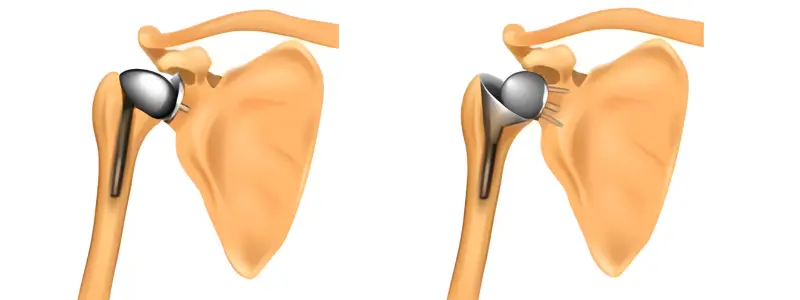
The worn ball and socket are replaced in their natural arrangement a polished metal ball on a stem, and a plastic socket. It's the standard choice for shoulder arthritis when the rotator cuff is still intact and working.
Partial Shoulder Replacement (Hemiarthroplasty)
Only the damaged ball (humeral head) is replaced, leaving the natural socket. Also called stemmed hemiarthroplasty, it's used when damage is limited to the ball and the socket is healthy.
Reverse Shoulder Replacement
Here the ball and socket are deliberately switched the ball is fixed to the socket side and the cup to the arm. This clever reversal lets the strong deltoid muscle power the arm instead of relying on a rotator cuff that's torn beyond repair. It's the right choice for cuff tear arthropathy and some complex fractures, and it's a genuinely different procedure from a standard replacement.
Revision Shoulder Replacement
When an earlier shoulder replacement loosens, wears or fails, revision surgery replaces or corrects it. Like other revision joint surgery, it's more complex than a first-time replacement and is planned individually.
Anatomic vs Reverse - How the Choice Is Made
The single most important decision in shoulder replacement is anatomic versus reverse, and it comes down to the rotator cuff - the group of tendons that stabilises and moves the shoulder. Your surgeon assesses it on MRI and confirms it during surgery.
| Anatomic (Total) Replacement | Reverse Replacement | |
|---|---|---|
| Rotator cuff | Intact and repairable | Torn beyond repair |
| What powers the arm | The rotator cuff | The deltoid muscle |
| Best for | Arthritis with a healthy cuff | Cuff tear arthropathy, complex fractures |
| Implant configuration | Natural (ball on arm) | Reversed (ball on socket side) |
Getting this decision right matters enormously - placing an anatomic replacement in a shoulder with a badly deficient cuff tends to fail early, which is exactly why careful pre-operative assessment (including detailed imaging and, where useful, CT-based planning of the socket) is worth the effort.
When Is Shoulder Replacement Needed?
Shoulder replacement is usually considered when pain and stiffness limit everyday movement and no longer respond to medicines, injections and physiotherapy. The pain often reaches the point where sleep is disturbed and even small movements hurt, and the joint feels weak as it loses motion. The conditions that lead here include osteoarthritis, rotator cuff tear arthropathy, rheumatoid and other inflammatory arthritis, osteonecrosis (loss of blood supply to the bone), fractures, and previously failed shoulder surgery. An examination plus X-ray and MRI imaging confirms both whether surgery is needed and which type suits your shoulder.
How Shoulder Replacement Is Performed
Under anaesthesia, the surgeon reaches the joint, removes the damaged parts of the ball and socket, and fits the implant chosen for your shoulder anatomic, reverse or partial. Component position, especially on the socket (glenoid) side, is planned carefully, because accurate placement is one of the biggest factors in a long-lasting, well-functioning result. The operation typically takes a couple of hours, and the specific approach is tailored to your anatomy and the type of replacement.
Recovery After Shoulder Replacement
Shoulder recovery is a patient process - the joint rewards steady, guided rehabilitation more than almost any other. Most patients are up and eating within a day or two and go home in a few days if there are no complications.
| Timeframe | What typically happens |
|---|---|
| First few days | Hospital stay; arm supported in a sling; pain controlled |
| 2–4 weeks | Sling worn to protect the repair; gentle guided movement begins |
| ~Several weeks | Sutures/staples removed; physiotherapy progresses |
| 6–8 weeks | Driving usually resumes once the sling is off and control returns |
| Up to a year | Strength and range built gradually through a structured programme |
Full strength develops over many months, so the exercises your physiotherapist sets - and doing them properly make a real difference to the final result. Recovery is individual, and patients travelling from Mahesana, Rajkot, Visnagar, Kadi and beyond have follow-up coordinated with this in mind.
Post-Operative Care
During your hospital stay, our physiotherapist teaches you specific exercises and precautions to continue at home. They're straightforward and take only a short while each day, but done consistently they shape the outcome of your shoulder replacement. Over the course of about a year, the muscles around the shoulder are gradually and deliberately stretched and strengthened. In the first month after surgery, avoid lifting anything heavier than about five pounds, and keep to the exercise plan your physiotherapist provides.
What Shoulder Replacement Costs in Ahmedabad
Across reputed private hospitals in Ahmedabad, shoulder replacement generally ranges from about ₹2–5 lakh, but it varies significantly by type: partial (hemiarthroplasty) tends to be lower, anatomic total replacement mid-range, and reverse shoulder replacement higher because the reverse implant system is different and more costly. Revision is typically the most expensive. Because anatomic and reverse use entirely different implants at different price points, an honest estimate should always specify which procedure is planned rather than quoting a single "shoulder replacement" package. Most mediclaim and health-insurance policies cover medically necessary surgery. These are general market ranges for a clear, itemised estimate for your case, please consult our team.
Meet Dr. Hiren Patel - Shoulder Replacement Specialist in Ahmedabad
The shoulder is the body's most mobile joint, and replacing it well means respecting that range and, above all, reading the rotator cuff correctly, because a damaged cuff changes which implant is right. Dr. Hiren Patel brings more than 14 years and 14,000+ surgeries to that judgment, across anatomic, reverse and revision shoulder replacement. He holds an MS (Orthopaedics) from B.J. Medical College, Ahmedabad, and completed international fellowships across four countries including one focused on sports medicine and shoulder surgery in South Korea and he assesses each shoulder personally before deciding the approach.
Why Patients Across Gujarat Choose PMG Hospital
A good shoulder replacement is really decided before surgery anatomic or reverse and that rests on a careful reading of the joint and the rotator cuff. Patients across Gujarat come to PMG for exactly that considered approach, alongside NABH-certified standards, care led directly by an experienced surgeon, and a structured rehabilitation plan (the shoulder responds to patient, guided physiotherapy more than almost any joint). Non-surgical options are weighed first, estimates name the specific procedure planned, and a straight second opinion is always on offer.
Frequently Asked Questions
What is shoulder replacement surgery?
Shoulder replacement (shoulder arthroplasty) removes the damaged surfaces of the ball-and-socket shoulder joint and replaces them with metal and plastic components, restoring smooth, pain-free movement. It's a highly successful operation for advanced arthritis, rotator cuff arthropathy, some fractures and failed earlier surgery - but the right type depends on the state of your rotator cuff.
What are the types of shoulder replacement?
There are four main types: total (anatomic) replacement of both ball and socket for arthritis with a healthy cuff; partial replacement (hemiarthroplasty) of just the ball; reverse replacement, which swaps the ball and socket for a cuff torn beyond repair; and revision, which corrects a failed earlier implant. Imaging and examination decide which suits you.
What is reverse shoulder replacement, and who needs it?
Reverse shoulder replacement deliberately switches the positions of the ball and socket, so the deltoid muscle powers the arm instead of a damaged rotator cuff. It's used when the cuff is torn beyond repair - as in cuff tear arthropathy - or for some complex fractures. It's a distinct procedure from a standard (anatomic) replacement, not a version of revision surgery.
What is the difference between anatomic and reverse shoulder replacement?
The key difference is the rotator cuff. An anatomic replacement keeps the natural ball-and-socket arrangement and relies on an intact cuff, suiting arthritis with a healthy cuff. A reverse replacement swaps the arrangement so the deltoid powers the arm, suiting a cuff torn beyond repair. Choosing correctly is essential, as the wrong choice can fail early.
When is shoulder replacement needed?
It's considered when shoulder pain and stiffness limit daily movement, disturb sleep and no longer respond to medicines, injections or physiotherapy. Common causes are osteoarthritis, rotator cuff arthropathy, rheumatoid arthritis, osteonecrosis, fractures and failed earlier surgery. Examination plus X-ray and MRI confirm whether surgery is needed and which type fits.
How long is recovery after shoulder replacement?
Most patients go home within a few days and wear a sling for about 2–4 weeks. Driving usually resumes around 6–8 weeks once the sling is off and control returns. Strength and range build gradually over many months, up to about a year, guided by physiotherapy. Doing the prescribed exercises properly strongly shapes the result.
How long does a shoulder replacement last?
Modern shoulder replacements are durable, with high success rates and many implants lasting 15 years or more, particularly with good rehabilitation and sensible activity. Longevity depends on the type of replacement, implant position, your activity level and general health, and regular follow-up helps keep the joint under review.
How much does shoulder replacement cost in Ahmedabad?
Shoulder replacement in Ahmedabad generally ranges from about ₹2–5 lakh, varying by type - partial tends to be lower, anatomic total mid-range, and reverse higher because its implant system is different and costlier. Revision is the most expensive. Most mediclaim policies cover it. A good estimate names the specific procedure; please consult us for an exact figure.
Talk to Our Orthopedic Team
If shoulder pain is stealing your sleep or your reach, you're welcome to bring your reports and scans for an honest assessment or a second opinion, and to leave with a clear plan. Call or WhatsApp +91 96627 70141, email pmghospital.ahm@gmail.com, or visit PMG Hospital at 3rd Floor, Athena Avenue, B/H Jaguar Showroom, near Eulogia Inn Hotel, Gota, S G Highway, Ahmedabad.