
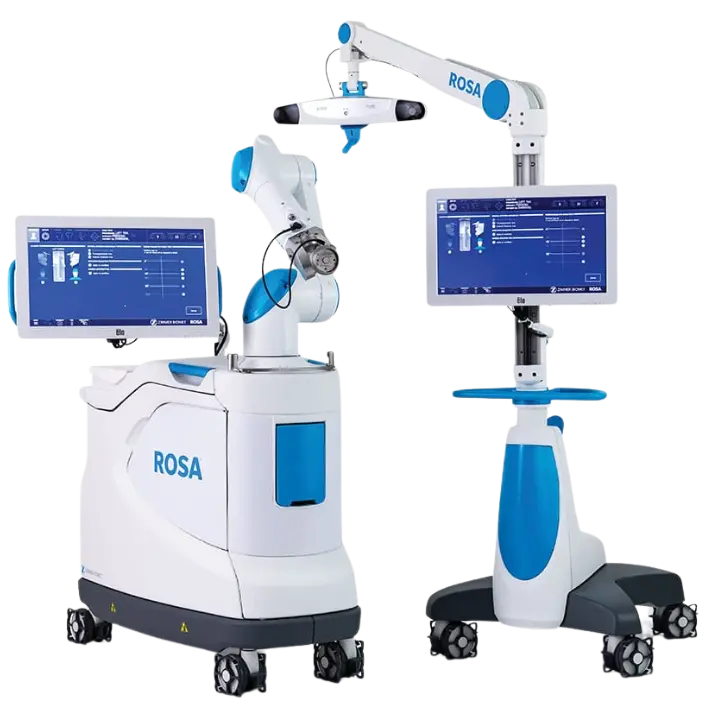
There's a lot of hype around robotic knee replacement, so here's the straight version. A surgical robot like ROSA doesn't perform the operation; it gives the surgeon precise, patient-specific measurements to plan and place the implant more accurately, while the surgeon stays in full control throughout. That accuracy is a genuine advantage in the right knee; it's also true that for a straightforward knee, an experienced surgeon achieves excellent results without it. At PMG Hospital, robotic knee replacement surgery in Ahmedabad uses the ROSA system, combined with a muscle-sparing approach called TriNova, led by Dr. Hiren Patel, for patients across Gujarat and this page explains, honestly, what it does and doesn't do.
What Is Robotic Knee Replacement?
Robotic-assisted knee replacement adds 3D planning and live, in-surgery measurement to a standard knee replacement. The robot builds a patient-specific model of your knee, the surgeon uses it to plan the exact implant size, position and limb alignment, and during the operation the system provides real-time feedback so the plan is executed precisely. The important word is assisted: the robot doesn't cut or decide on its own; it's a precision instrument that helps the surgeon do accurately what they already do well. Roughly one in five patients aren't fully satisfied after a conventional knee replacement, often from small alignment or balance issues, and reducing those is exactly what robotic assistance aims at.
How ROSA Works - From X-ray to the Operating Table
The ROSA workflow is straightforward: your knee X-rays are sent to a planning process that transforms them into a digital, 3D model of your anatomy; a surgical plan is then built on that patient-specific model and displayed on the ROSA interface. In theatre, ROSA measures your knee live as the surgery proceeds, so the implant size, position and limb alignment follow the plan rather than the feel of the moment. The surgeon reviews the data, makes any fine adjustments, and carries out the operation with the robot confirming, in real time, that everything matches the plan.
TriNova - Three Decisions Made in Theatre
Here's what makes the knee programme at PMG distinctive. How much of your knee is disturbed during surgery comes down to three separate choices: the robot, the surgical approach, and the tourniquet. TriNova is all three, applied together where they suit the knee. It's worth understanding each one, because together they aim not just at an accurately-placed implant, but at a knee that's been handled more gently along the way.
Robotic Assistance
ROSA measures the knee live during surgery, so the implant size, position and limb alignment follow the plan rather than the feel of the moment. In practice this means more consistent, accurate alignment, the part of robotic surgery that's genuinely well supported by evidence and it matters most in knees with complex anatomy or a deformity, where getting the alignment exactly right by hand is hardest.
Subvastus Approach
The knee is opened underneath the vastus medialis muscle instead of cutting through the quadriceps tendon so the muscle that straightens your leg is left undisturbed. This is a muscle-sparing route into the joint, and by not dividing the quadriceps mechanism, it can support an earlier return of active leg-straightening and quicker early function. It's a real difference in how the knee is entered, not just marketing.
Tourniquet-less Surgery
The operation is done without a thigh tourniquet, so the blood supply to the leg muscles isn't cut off during surgery. A tourniquet is traditionally used to keep the surgical field dry, but squeezing off the blood supply can contribute to thigh pain and temporary weakness of the quadriceps afterwards. Doing without it keeps the muscles perfused throughout, which can mean less thigh pain and better early quad function.
| TriNova component | What it is | Why it helps |
|---|---|---|
| Robotic assistance (ROSA) | The robot measures the knee live, so implant size, position & alignment follow the plan | More accurate, consistent alignment most valuable in complex knees |
| Subvastus approach | The knee is opened beneath the vastus medialis, not through the quadriceps tendon | Spares the leg-straightening muscle can aid earlier active movement |
| Tourniquet-less surgery | The operation is done without a thigh tourniquet | Keeps the leg muscles perfused can mean less thigh pain, better early quad function |
TriNova is applied where the three choices suit the knee; it isn't a fixed package forced onto every case, but a set of options matched to the individual knee.
Is Robotic Knee Replacement Actually Better?
The honest answer, based on the evidence: robotic assistance reliably improves alignment accuracy and reduces "outliers" (knees left slightly off-target), and large studies have linked it to fewer complications and a slightly shorter hospital stay. What the evidence doesn't yet show is a dramatic difference in early pain or function for most patients, the first few months feel similar to a well-done conventional replacement and long-term (15–20 year) comparisons of implant survival are still being studied. So robotic assistance is a genuine, worthwhile precision tool, especially in complex knees, rather than a magic upgrade that changes everything.
| Robotic-assisted (ROSA) | Conventional | |
|---|---|---|
| Alignment | Live, data-guided; fewer outliers | Highly reliable in experienced hands |
| Early pain & function | Generally similar to conventional | Generally similar to robotic |
| Complications / stay | Some studies show fewer, slightly shorter | Well-established |
| Long-term survival data | Still emerging | Decades of proven results |
| Cost | Higher (the technology) | Lower |
Who Benefits Most from Robotic Assistance?
Robotic assistance tends to add the most where precise alignment is hardest to achieve by hand: knees with significant deformity or unusual anatomy, tighter alignment goals, and more complex cases. For a straightforward knee in the hands of an experienced surgeon, conventional surgery gives excellent, reliable results which is why the honest approach is to use the robot where it genuinely helps, not to sell it to everyone. What benefits every patient, robotic or not, is a careful assessment and, at PMG, the muscle-sparing TriNova technique where it suits the knee.
Robotic Knee Replacement Cost in Ahmedabad
Robotic knee replacement costs more than conventional surgery, because of the technology involved and it's fair to weigh that against the benefit for your specific knee.
| Procedure | General cost in Ahmedabad |
|---|---|
| Conventional knee replacement | ₹1.8 – 2.8 lakh |
| Robotic-assisted knee replacement | ₹2.5 – 3.8 lakh |
The final figure depends on the implant, room category and your specific case. Most mediclaim and health-insurance policies cover medically necessary knee replacement, robotic or conventional. For an exact estimate, please consult our team.
Meet Dr. Hiren Patel - Robotic Knee Replacement Surgeon in Ahmedabad
The honest truth about robotic knee replacement is that the robot is only as good as the surgeon using it; it's a precision tool, not an autopilot. Dr. Hiren Patel uses the ROSA system and pairs it with the muscle-sparing subvastus approach and tourniquet-less technique as part of his TriNova method, where they genuinely suit the knee. As a robotic knee replacement surgeon Ahmedabad patients seek out 14+ years, 14,000+ orthopedic surgeries, an MS (Orthopaedics) from B.J. Medical College, Ahmedabad, and international fellowships in knee surgery he'll also tell you honestly when a straightforward knee will do just as well with conventional surgery. As a robotic knee replacement specialist Ahmedabad trusts, his focus is the result, not the marketing.
Why Patients Across Gujarat Choose PMG Hospital
Robotic technology only helps if it's used with judgment so as a robotic knee replacement hospital Ahmedabad and across Gujarat rely on, PMG's approach is to use the ROSA system where it genuinely improves the result, and to be honest when it doesn't change much. What sets the knee programme apart is TriNova combining robotic guidance with a muscle-sparing subvastus approach and tourniquet-less surgery so the aim isn't only an accurately-placed implant, but a less-disturbed knee that recovers comfortably. NABH-certified standards, an experienced surgeon and an in-house physiotherapy team round it out, and a second opinion is always available.
Frequently Asked Questions
Is robotic knee replacement better than conventional surgery?
Robotic assistance reliably improves alignment accuracy and reduces off-target results, and large studies link it to fewer complications and a slightly shorter stay. But early pain and function are generally similar to a well-done conventional replacement, and long-term survival comparisons are still emerging. It's a genuine precision tool - most valuable in complex knees - rather than a magic upgrade. For a straightforward knee, conventional surgery works excellently.
What is ROSA?
ROSA (Robotic Surgical Assistant) is a robotic system that helps the surgeon plan and perform knee replacement precisely. It builds a 3D model of your knee from X-rays, the surgeon plans the implant size, position and alignment on it, and during surgery ROSA measures the knee live so the plan is executed accurately. The surgeon stays in full control - ROSA assists, it doesn't operate on its own.
What is TriNova?
TriNova is PMG Hospital's approach to knee replacement, combining three choices made during surgery: robotic assistance (ROSA) for accurate alignment, a subvastus approach that opens the knee beneath the muscle rather than cutting the quadriceps tendon, and tourniquet-less surgery that keeps the leg's blood supply flowing. Together they aim for an accurately-placed implant and a more gently-handled knee. They're applied where they suit the individual knee.
Does robotic knee replacement mean less physiotherapy?
No - physiotherapy is essential after any knee replacement, robotic or conventional, and it's what restores strength and movement. Robotic surgery doesn't remove the need for rehab. What the muscle-sparing parts of TriNova (the subvastus approach and tourniquet-less technique) can do is support a more comfortable early recovery, but committed physiotherapy remains central to a good result. Any claim of "no physio needed" isn't accurate.
Is robotic knee replacement worth the extra cost?
It depends on your knee. For complex anatomy, deformity or tighter alignment goals, the added precision can be genuinely worthwhile. For a straightforward knee, conventional surgery in experienced hands gives excellent results, so the extra cost may not add much. The honest way to decide is a proper assessment of your specific knee - not a blanket "robotic is always better."
Does robotic surgery mean smaller incisions and faster recovery?
Not exactly. The incision for a robotic knee replacement is broadly similar to conventional surgery - the main difference the robot makes is alignment accuracy, not a smaller cut. Early recovery is generally similar to conventional surgery in the evidence. Where PMG's approach can help early recovery is the muscle-sparing subvastus and tourniquet-less parts of TriNova, rather than the robot alone.
How much does robotic knee replacement cost in Ahmedabad?
Robotic knee replacement in Ahmedabad generally ranges from about ₹2.5–3.8 lakh, compared with roughly ₹1.8–2.8 lakh for conventional surgery - the difference being the technology. The final figure depends on the implant, room category and your case. Most mediclaim policies cover medically necessary knee replacement, robotic or conventional. Please consult us for an exact estimate.
Who is a good candidate for robotic knee replacement?
Robotic assistance adds the most for knees with significant deformity or unusual anatomy, tighter alignment goals, and more complex cases. Any patient needing a knee replacement can be considered, but for a straightforward knee, conventional surgery is equally excellent. The right call comes from assessing your specific anatomy and goals, rather than assuming robotic is automatically the better choice for everyone.
Talk to Our Orthopedic Team
If you're weighing robotic versus conventional knee replacement, an honest assessment of your specific knee will tell you whether the added precision is worthwhile for you. Bring your reports and X-rays. Call or WhatsApp +91 96627 70141, email pmghospital.ahm@gmail.com, or visit PMG Hospital at 3rd Floor, Athena Avenue, B/H Jaguar Showroom, near Eulogia Inn Hotel, Gota, S G Highway, Ahmedabad.